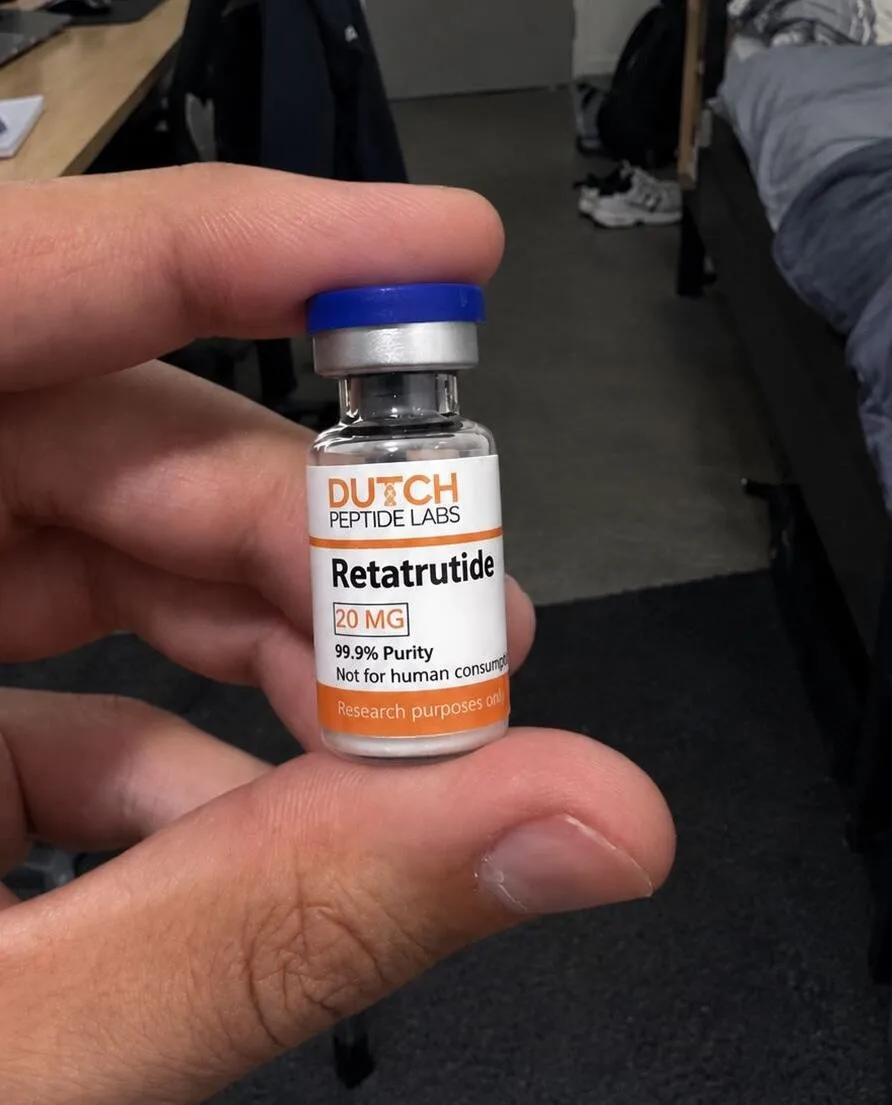





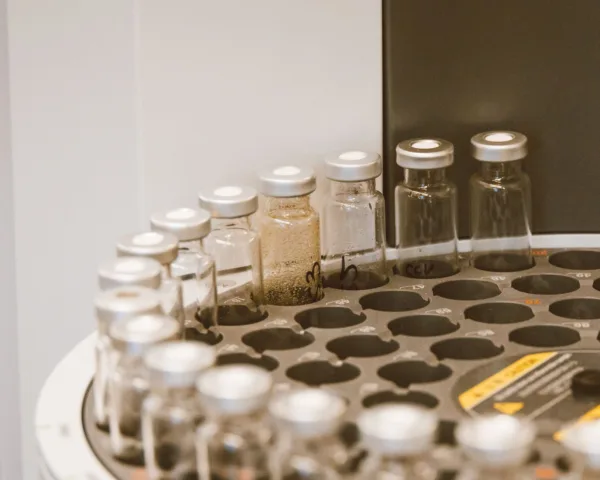
Anyone ordering research peptides almost always receives a white, airy powder in a vial — not a liquid, not an oil, but a granular or sometimes glassy “cake”. That is the result of lyophilisation, also known as freeze-drying. It is not a marketing choice or a packaging trick, but a technical process that directly determines how stable a peptide is, how long it can be stored and how reliable the analytical results on the accompanying Certificate of Analysis are. In this article we explain what lyophilisation involves, why peptides are so sensitive to it, and what the technique means for laboratory use.
Why peptides are vulnerable in solution
A peptide is a chain of amino acids joined by peptide bonds. That chain is stable as a solid, but as soon as a peptide is dissolved in water it becomes vulnerable to a number of degradation routes: hydrolysis of the peptide bond, deamidation of certain side chains, oxidation of sensitive amino acids such as methionine or cysteine, and aggregation in which peptide molecules clump together. Each of these processes runs faster the more water molecules are available to react with, and the higher the temperature. A solution left at room temperature can show measurable decay within days. The same peptide as a dry powder, stored at low temperature, remains stable for months to years. The difference therefore lies not in the molecule itself, but in the presence of free water.
The lyophilisation process step by step
Freeze-drying consists of three phases that take place one after another in a vacuum chamber:
- Freezing — the peptide solution is first frozen rapidly, usually to below -40°C. The water forms ice crystals and the peptide is left behind in a concentrated, solid matrix between those crystals.
- Primary drying (sublimation) — under reduced pressure and controlled, gentle heating, the frozen water passes directly from ice to water vapour without melting first. This is the slowest part of the process and can take hours to days, depending on the volume.
- Secondary drying (desorption) — the remaining water bound to the peptide, which was not present as ice, is removed at a slightly higher temperature. This brings the residual moisture content down to typically below 1-2%.
Because the water sublimates rather than boils, the structure of the peptide is preserved far better than with heat drying. That makes lyophilisation suitable for molecules sensitive to heat-related denaturation.
What lyophilisation delivers for research use
For laboratories a lyophilised product is more practical than a ready-made solution for a few reasons. First, stability: without free water most degradation routes are all but halted, which allows a longer shelf life at -20°C. Second, weight and volume: a powder is more compact and easier to ship and store than a large quantity of liquid. Third, flexibility: researchers can decide for themselves which solvent, which concentration and which buffer system they use to reconstitute the peptide, matched to the specific experimental protocol, instead of being tied to a pre-selected formulation.
Points to watch with a lyophilised sample
The quality of the end product depends heavily on how carefully the process was carried out. A well-lyophilised cake is usually white to pale yellow, airy, and roughly retains the shape of the vial it was dried in. Discolouration, or a collapsed or glassy “melted” appearance, can indicate warming that was too rapid during the process, which has led to partial local melting (collapse) and can affect stability. Residual moisture content is a parameter that can in principle be determined analytically and relates directly to the expected stability during storage. In some formulations cryoprotectants such as mannitol or trehalose are added to protect the structure during freezing; these are then listed in the composition on the accompanying documentation. When opening a vial it is common practice in laboratory protocols to let the pressure equalise before opening and not to expose the powder to unnecessary humidity, since lyophilisate can be strongly hygroscopic.
In short
Lyophilisation is not a side issue in the production of research peptides, but a decisive step for the usability of the material. The process turns a vulnerable, water-soluble chain of amino acids into a stable solid form that is easy to store, ship and document. For anyone using peptides in laboratory research it is therefore worth looking not only at purity and molecular weight, but also at how the material has been dried and packaged.
The products and information on this page are intended solely for laboratory and research purposes. Not intended for human or animal consumption, diagnostic use or therapeutic application.