




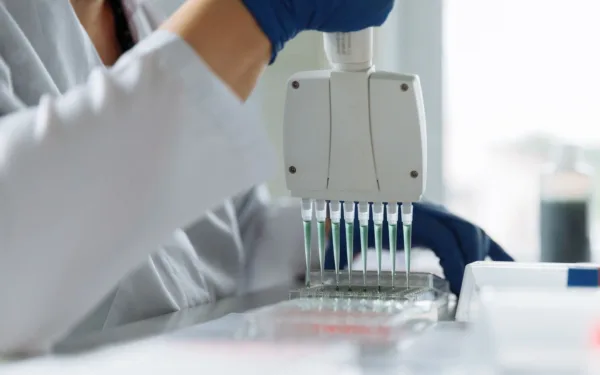
Every research peptide used in a laboratory begins as a chain of individual amino acids coupled together step by step. The most widely used production method for this is solid-phase peptide synthesis (SPPS), a technique that has been the standard in peptide chemistry for decades. For researchers buying peptides it is useful to understand how this process works, because the synthesis method directly determines which impurities can arise and how consistent a batch is.
The principle of solid-phase synthesis
In SPPS the peptide chain is built up on an insoluble resin bead that acts as a fixed anchor. The first amino acid is coupled covalently to the resin, after which the chain is extended amino acid by amino acid, always starting at the C-terminus. Because the growing peptide is physically attached to the resin support, excess reagents and by-products can simply be washed away after each step without losing the product. That is the great advantage over synthesis in solution, where intermediate purification of every step is all but unworkable.
The synthesis cycle: coupling, deprotection, washing
A single extension step consists of a fixed cycle repeated throughout the synthesis:
- Deprotection — the protecting group on the amino-terminal end of the growing chain is removed, usually with a base such as piperidine in the common Fmoc strategy.
- Coupling — the next amino acid, carrying an activated carbonyl group, is added and forms a peptide bond with the liberated amino group.
- Washing — excess reagent and by-products are rinsed from the resin with solvent before the next cycle begins.
For a peptide of twenty amino acids this means twenty of these cycles, each with its own chance of incomplete coupling. That is precisely where the greatest quality risk arises: if a coupling step does not run to completion, a fraction of the chains remains one amino acid shorter. These so-called deletion sequences closely resemble the desired product in mass and structure and are one of the reasons subsequent purification is indispensable.
From crude product to purified peptide
Once the full chain has been built, the peptide is cleaved from the resin and the last protecting groups are removed. The result is a crude mixture: besides the desired peptide it contains deletion sequences, modified variants and remnants of the synthesis chemistry. Reversed-phase HPLC is the usual method for separating this mixture on the basis of hydrophobicity, collecting only the fraction with the correct retention behaviour. The relationship between synthesis quality and purification effort is direct: the more efficiently each coupling step runs, the fewer by-products have to be purified away and the higher the eventual yield.
Lyophilisation: stabilisation for transport and storage
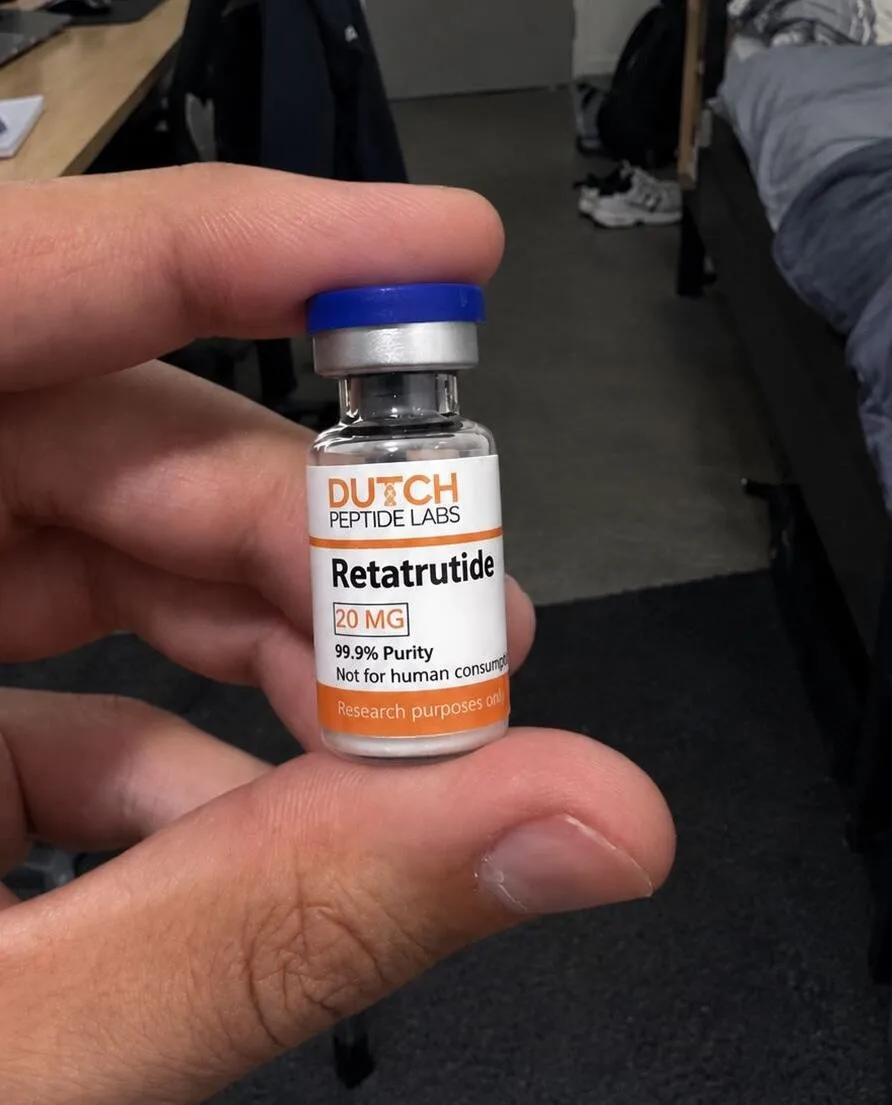
After purification the peptide sits in an aqueous or organic solution, a form unsuited to long-term storage. Lyophilisation — freeze-drying under vacuum — removes the solvent by sublimation, without the peptide having to endure the thermal load of ordinary evaporation. The result is a dry, porous powder considerably more stable than the solution it came from. This step also explains why peptides are usually supplied as a lyophilised powder: it limits degradation during transport and gives the researcher control over when reconstitution happens.
Why this matters when choosing research material
For a researcher purchasing peptides the synthesis method itself is usually invisible, but its consequences are not: batch-to-batch consistency, the proportion of deletion sequences, and the extent to which a certificate of analysis actually corresponds to the batch received. A well-documented synthesis and purification process is therefore at least as relevant as a single purity percentage on a label. Anyone who understands the underlying chemistry can interpret certificates of analysis and specifications better, and ask a supplier more pointed questions.
The products and information on this website are intended solely for laboratory and research purposes. They are not intended for human or animal consumption, diagnostic use or therapeutic application.