
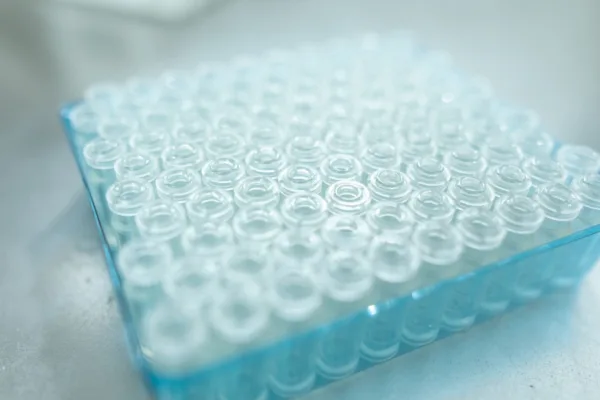
A researcher who carefully reconstitutes, dilutes and pipettes a peptide solution usually assumes that the concentration in the vial matches what was weighed out. Yet analytical research shows that a considerable part of a peptide in solution can disappear without anything being spilled or degraded. The cause is adsorption: the peptide sticks to the wall of the vial or tube. This article discusses how that mechanism works, when the risk is greatest and which measures limit the effect.
What is adsorption and why does it happen
Adsorption is the process by which molecules attach to a surface instead of remaining dissolved in the liquid. For peptides this arises because the interaction with the wall material is energetically more favourable than the interaction with the solvent. Several forces play a part: hydrophobic interactions between non-polar amino acid side chains and the surface, electrostatic attraction between charged residues and surface groups, and hydrogen bonds between the peptide backbone and polar groups on glass or plastic. At low concentrations this effect is proportionally greatest, because a fixed number of binding sites on the surface can capture a larger part of the total quantity of peptide.
Glass versus plastic: different mechanisms
Glass contains silanol groups (Si-OH) that are negatively charged at neutral to basic pH. This makes glass surfaces particularly attractive to cationic or basic peptides, which can bind strongly via electrostatic interaction. Plastic tubes such as polypropylene lack these charged groups but offer instead a hydrophobic surface to which peptides with hydrophobic patches — sequences rich in leucine, valine or phenylalanine — can attach. Neither material is therefore universally “safe”; which material causes the most loss depends on the physicochemical properties of the specific peptide.
When the risk is greatest
A number of factors increase the risk of measurable loss through adsorption:
- Low concentrations, where a fixed surface loss makes up a greater percentage of the total quantity.
- A high ratio between surface area and volume, as in small tubes or thin pipette tips.
- Long contact time, for example during extended storage or incubation in the same vial.
- Repeated transfer between several containers, where every new surface can capture peptide again.
Publications on the adsorption of cationic, membrane-active peptides have shown that under unfavourable conditions more than 90 per cent of the peptide can disappear from solution through binding to the wall. That is a difference that can directly affect downstream analyses, such as concentration determinations or activity tests, if it is not taken into account.
Strategies for limiting loss
There are several ways of reducing adsorption loss in practice:
- Low-binding labware: tubes and plates with a modified, less reactive surface are specifically designed to reduce protein and peptide binding.
- Siliconisation: coating glass or plastic surfaces with a silicone layer reduces the availability of binding sites.
- Carrier proteins or blocking agents: adding BSA to a buffer solution, for example, can occupy binding sites on the surface before the peptide comes into contact with them, although this has to be weighed against possible interference with downstream detection methods.
- Surfactants: low concentrations of a suitable surfactant can reduce non-specific interactions between peptide and wall.
- Minimising transfer steps: every time a solution is moved to a new container, a new moment of adsorption arises. Where possible it is worth limiting the number of transfers.
Recognising and documenting adsorption
Because adsorption gives no visible signal, the effect often only becomes apparent when a concentration measurement or bioassay yields a lower value than expected from the quantity weighed out. For critical applications it is advisable to carry out a short recovery test beforehand: a known concentration is placed in the intended labware, after which the remaining concentration is determined following a representative contact time. Such a test shows which material and which conditions work best for a specific peptide, and provides numerical support that can be included in laboratory documentation.
Adsorption to vial walls is a well-documented but often underestimated phenomenon in peptide research. By deliberately weighing material choice, concentration and contact time, and carrying out a recovery test where necessary, researchers can prevent part of their sample from being lost unnoticed before the actual measurement begins.
The products and information of Dutch Peptide Labs are intended solely for laboratory and research purposes. They are not intended for human or animal consumption, diagnostic use or therapeutic applications.