

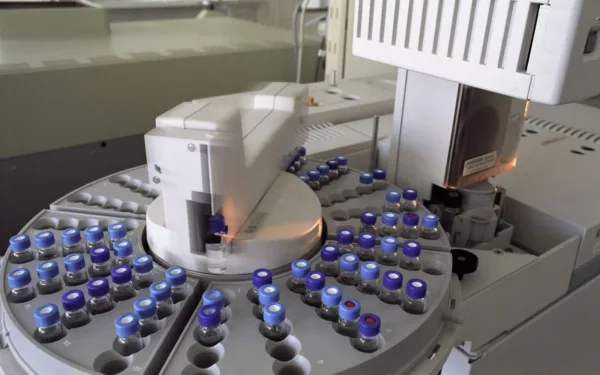
A peptide leaving the door 99% pure according to its certificate of analysis is not automatically still so when it is used in the laboratory. Peptides are chemically fragile molecules: the peptide bond, side chains and three-dimensional folding can be damaged in several ways by time, temperature, light and the environment the molecule finds itself in. For anyone buying and managing peptides for laboratory research it is useful to understand the routes by which degradation occurs, and which variables matter most. This article gives an overview of the main degradation mechanisms, separately from the reconstitution and storage protocols already covered on this blog.
What do we mean by peptide stability?
Stability refers to the ability of a peptide to retain its chemical structure, purity and biological identity over a given period and under defined conditions. A peptide can still look physically intact — clear, without precipitate — while at molecular level degradation products have already arisen that become visible with techniques such as HPLC or mass spectrometry. Stability research usually distinguishes chemical degradation (change of the covalent structure) from physical degradation (change of conformation or aggregation state), and both categories are relevant to the reliability of experimental results.
Chemical degradation routes
Hydrolysis
The peptide bond itself is susceptible to hydrolysis: in the presence of water the bond between amino acids can split, particularly at extreme pH values or elevated temperature. This is one of the reasons many peptides are considerably more stable as a lyophilisate — that is, without water — than in solution.
Oxidation
Amino acids with sulphur-containing or aromatic side chains, such as methionine, cysteine, tryptophan and tyrosine, are susceptible to oxidation through exposure to oxygen or light. Oxidation can change the charge, hydrophobicity and ultimately the three-dimensional structure of the peptide, which shows up in analytical data as extra peaks or a shifted mass.
Deamidation
Asparagine and glutamine residues can be converted via deamidation into aspartic acid and glutamic acid respectively. This process runs faster at higher pH and temperature, and changes the net charge of the peptide, which can affect chromatographic behaviour among other things.
Aggregation
Besides covalent changes, peptides can aggregate physically: individual molecules clump together into larger complexes, often via hydrophobic interactions or misfolded intermediate structures. Aggregation is not always chemical in nature, but it does have direct consequences for the reproducibility of an experiment, because the effective concentration of the intact, monomeric peptide falls.
Physical and environmental factors
A number of external variables determine how quickly the above routes take place:
- Temperature: higher temperatures accelerate virtually all degradation reactions; this is why lyophilisate is usually stored at -20°C or colder.
- Light: UV and visible light can damage photosensitive side chains, especially on prolonged exposure.
- pH of the solution: both hydrolysis and deamidation are strongly pH-dependent; most peptides have a narrow pH window in which they stay relatively stable.
- Freeze-thaw cycles: repeatedly freezing and thawing an already reconstituted solution can cause local concentration changes and mechanical stress, which promotes aggregation.
Lyophilisate versus solution
The great majority of the degradation routes above require water as a reaction medium or as a solvent for molecular mobility. That explains why lyophilised powder, provided it is kept dry and dark, generally has a considerably longer shelf life than a reconstituted solution. Once a peptide has been brought into solution, most degradation mechanisms run faster, and the time window in which reliable research can be done shortens accordingly.
Practical implications for laboratory work
For researchers this chemistry translates into a number of concrete considerations: keep peptides as lyophilisate as long as possible until just before use, limit exposure to light and temperature fluctuations, minimise the number of freeze-thaw cycles, and carry out periodic analytical checks — via HPLC, for example — when a peptide is used in solution over a longer period. Documenting batch number, date of receipt and storage conditions moreover makes it possible to trace deviant results back to possible stability problems rather than experimental variables.
Stability is therefore not a static fact on a certificate, but a dynamic process influenced by how a peptide is handled after receipt. A good understanding of the underlying chemistry helps researchers make considered choices about storage, use and quality control within their own laboratory protocols.
Disclaimer: The products and information on this website are intended solely for laboratory and research purposes. They are not intended for human or animal consumption, diagnostic use or therapeutic application.