






A Certificate of Analysis (COA) gives enough information to use a peptide batch for research, provided the document contains batch-specific HPLC data, mass spectrometry, net peptide content and relevant safety measurements. If one of these elements is missing, the COA is incomplete for reliable identification and dosing.
On receiving a COA, check at least the following points:
- Batch number: is it stated exactly, and does it match the number on the vial?
- Test date: is the analysis recent enough, and is there a retest date?
- HPLC chromatogram: is the raw trace present with retention times and integration parameters?
- MS spectrum: is the mass spectrometry spectrum present with the observed mass?
- Net peptide content: is the percentage stated (corrected for water and counterions)?
- Endotoxin value: is the value reported, and does it meet the threshold for the intended application?
- Laboratory accreditation: is the testing laboratory accredited, preferably to ISO/IEC 17025?
If the MS spectrum or the chromatogram is missing, the COA is insufficient for scientifically sound identification. A purity percentage without raw data is a marketing claim, not analytical evidence.
Contents
- What is a COA for peptides and why is it always batch-linked?
- Which fields should you find in a peptide COA?
- What does HPLC measure and how do you read a chromatogram correctly?
- How does mass spectrometry confirm the identity of a peptide?
- How do you calculate net peptide content and why does the salt form affect your dosing?
- Which additional quality parameters determine suitability for your experiment?
- Which red flags on a COA point to unreliable data?
- Step-by-step COA review: a checklist for laboratory staff
- How do you compare COAs from different batches side by side?
- Why are method documentation and laboratory accreditation decisive for reliability?
- How does Dutchpeptidelabs structure COAs and quality control?
- Key insights
- Transparent COAs as the foundation of reliable science
- Dutchpeptidelabs: batch COAs and lab results directly available
- Useful resources and standards for further verification
What is a COA for peptides and why is it always batch-linked?
A COA is a batch-specific certificate of analysis reporting the identity, purity and safety parameters of a peptide at the moment of analysis. The document is not a generic product specification, but a snapshot of one specific production batch.
A COA only becomes scientifically usable when the batch number on the document matches the batch number on the vial exactly. If it does not, traceability lapses, and with it the reproducibility of every experiment based on that batch.
That batch-linked character is no formality. Peptides can vary between production batches in purity, salt form and moisture content. A COA from a previous batch says nothing about the current delivery. A COA is moreover a snapshot: the document says nothing about degradation during transport or incorrect storage after delivery. The test date and any retest date determine the horizon of validity.
For Dutch laboratories there is an additional consideration. European procurement of tested peptides reduces logistical risks such as customs delay and temperature deviations during transport, and increases traceability. External, independent testing laboratories such as Eurofins or SGS, accredited to ISO/IEC 17025, offer an extra layer of verification that in-house testing cannot provide.
The key points that make a COA batch-linked:
Which fields should you find in a peptide COA?
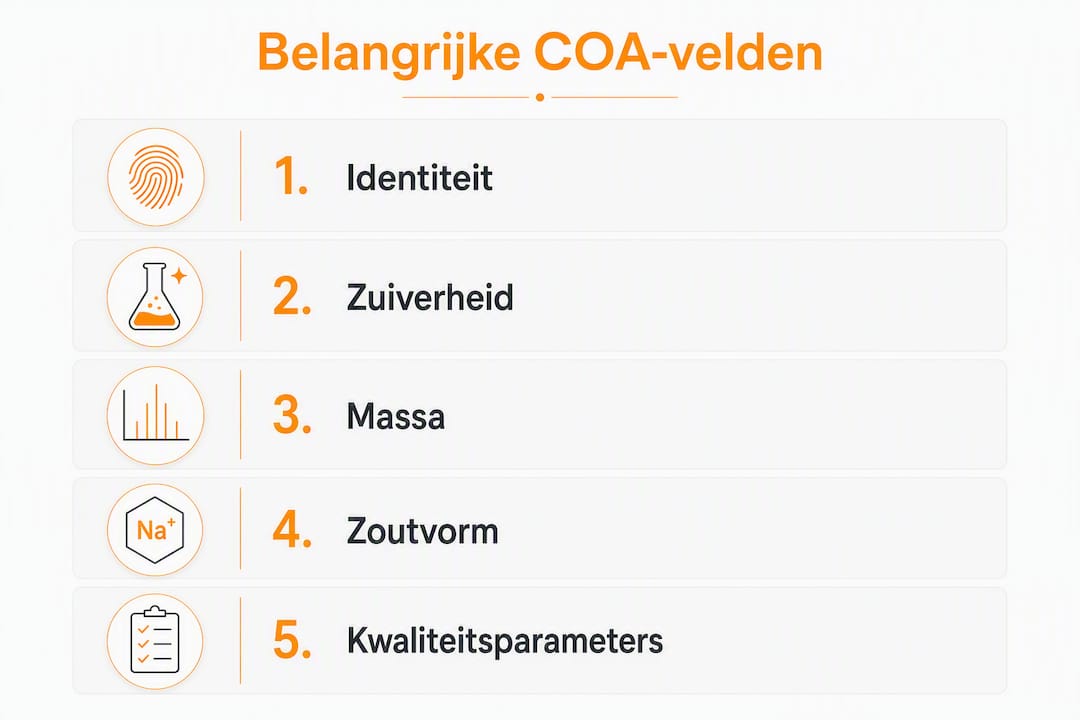
A complete COA contains at least six categories of field. If a category is missing, the COA is unusable for certain applications.
Header fields
- Product name and any synonyms or abbreviations
- Amino acid sequence (one-letter or three-letter codes)
- Batch or lot number
- Packaging unit (mg or µmol)
- Test date and retest date
Identity fields
- Calculated molecular mass (monoisotopic or average)
- Observed mass from MS analysis, including ionisation technique (ESI or MALDI)
- Instrument model and measurement settings
Purity fields
- HPLC purity as area% at the detection wavelength (usually 214 nm or 220 nm)
- Raw chromatogram trace with labelled peaks and retention times
- Integration parameters and integration table
Content fields
- Net peptide content as a percentage of total mass
- Moisture content or loss on drying (LOD)
- Salt form (TFA, acetate or other counterions)
Safety fields
- Endotoxin value (EU/mg)
- Residual solvents, assessed against ICH Q3C criteria
- Heavy metals (where relevant to the application)
- Bioburden (for biological material or non-sterile applications)
Documentation fields
- Description of the analytical method (column type, eluent, gradient)
- Name and accreditation status of the testing laboratory
- Acceptance criteria per parameter
Pro tip: When in doubt, always ask for the raw chromatogram trace and the integration parameters. A COA stating only a purity percentage without underlying data cannot be verified independently.
What does HPLC measure and how do you read a chromatogram correctly?
HPLC purity (area%) measures the relative UV-detectable peak area of the main peak against all detected peaks. It is not a direct measure of the absolute peptide mass in the vial. A value of 98% means that 98% of the UV-absorbing area belongs to the main peak, not that 98% of the weight is pure peptide.
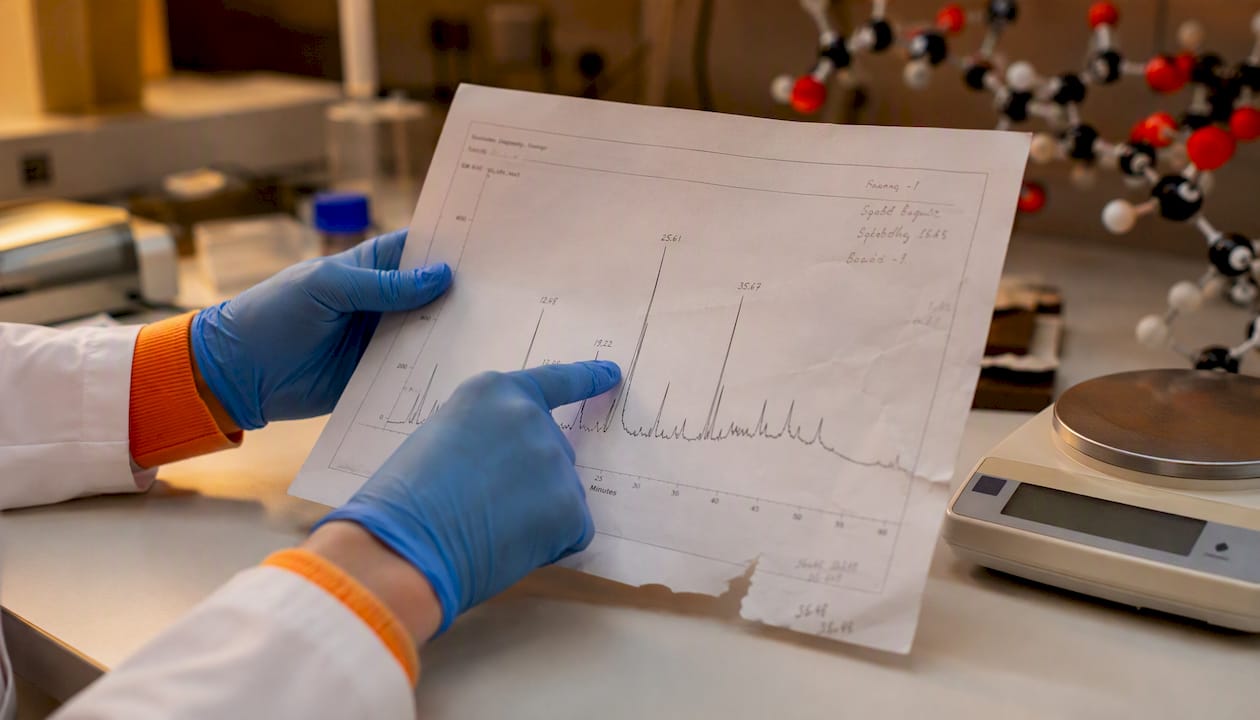
Chromatograms contain more information than the percentage alone. Retention time indicates when the main peak eluted and is an indicator of reproducibility between batches. Peak shape (symmetry, shoulders, tailing) signals possible co-eluting impurities. The baseline shows noise and drift. Small peaks before or after the main peak are impurity peaks that should be included in the integration table.
When is a 98–99% value reliable? Only if the chromatogram shows the following characteristics: a sharp, symmetrical main peak without shoulders, a flat baseline, labelled retention times and a complete integration table. Without the trace, the percentage cannot be verified.
Limitations that HPLC does not make visible:
- Substances that do not absorb UV (counterions, water, some additives) do not appear in the chromatogram.
- Salt form and moisture content contribute to total weight but not to the area%.
- Co-eluting impurities with a comparable retention time can hide within the main peak.
Pro tip: Always ask for the raw chromatogram as a PDF or image, including the integration parameters. A table with area% values alone is insufficient for independent verification.
How does mass spectrometry confirm the identity of a peptide?
Without MS data a COA is incomplete: HPLC shows that a dominant peak is present, but does not confirm that this peak is the intended peptide. MS provides that confirmation by measuring the molecular mass directly.
What to check in the MS spectrum:
- Instrument model and measurement settings: — must be stated in the COA for reproducibility.
A statement such as “MS confirmed” without a spectrum or an observed mass is analytically insufficient. Any COA claiming identity confirmation must show the spectrum with the measured mass values.
Pro tip: Compare the observed mass with the calculated monoisotopic mass of the stated sequence. Free tools such as Bachem’s Peptide Mass Calculator or the ExPASy server let you check this quickly.
How do you calculate net peptide content and why does the salt form affect your dosing?
Net peptide content is the percentage of actual peptide in the freeze-dried mass, after correcting for water and counterions. A 5 mg vial often contains a lower weight of pure peptide, depending on the salt form and moisture content. Anyone not correcting for this is working with a systematic under-dose.
A worked example: suppose a 5 mg vial has a net peptide content of 78%.
- Effective peptide mass = 5 mg × 0.78 = 3.9 mg of pure peptide
- If you want a stock solution of 1 mg/ml, dissolve the 3.9 mg in 3.9 ml of solvent, not in 5 ml.
- Document the net content and the volume used in your laboratory notebook for reproducibility.
Salt form has a direct influence on this figure. TFA salt (trifluoroacetic acid) is heavier than acetate salt; a peptide as the TFA salt therefore has a lower net peptide content at equal weight. Moisture content raises the total weight without contributing to the peptide mass. A moisture content above 8% moreover increases the risk of hydrolysis and affects stability during storage.
Practical considerations:
- Always use the net peptide content as the basis for dosing calculations, not the nominal vial weight.
- Note the salt form in your experimental metadata; this is relevant when comparing with literature data.
- Correct for moisture content during long-term storage or where the COA states a high LOD percentage.
Which additional quality parameters determine suitability for your experiment?
For most in vitro and in vivo research applications in the EU, an endotoxin level below 0.1 EU/mg is considered acceptable. Higher values can disturb cellular responses and lead to artefacts that complicate the interpretation of experimental results.
For in vitro and in vivo applications, aim for an endotoxin value below 0.1 EU/mg. Higher values are reason to contact the supplier or to reject the batch for sensitive biological assays.
Residual solvents are assessed against ICH Q3C criteria, which classify solvents by toxicological risk. Class 1 solvents (such as benzene) are prohibited or strictly limited; class 2 solvents (such as acetonitrile) have fixed limits. A COA stating residual solvents should specify the class or the limits applied.
Heavy metals can cause toxic effects in cell culture models even at trace concentrations. Analytical methods such as ICP-MS offer the sensitivity needed for reliable quantification at ppb level. Not all COAs report heavy metals as standard; ask about them when the application is sensitive to metallic contamination.
Water content and loss on drying (LOD): a moisture content above 8% increases the risk of hydrolysis and reduces stability during storage. Dry, freeze-dried peptides with a low LOD are more stable and easier to dose.
Bioburden and mycotoxins are relevant for peptides used in biological systems or non-sterile applications. Standard COAs do not always state these parameters; ask about them where the experimental context requires it.
Which red flags on a COA point to unreliable data?
A COA without a chromatogram is often used as a marketing document; genuine research COAs show data, method and external laboratory. The following signals point to a document that does not meet the requirements for scientific use:
- Generic or batch-independent COAs: — if all batches show identical purity percentages and retention times, the COA has probably not been drawn up per batch.
Step-by-step COA review: a checklist for laboratory staff
Work through these steps for every new batch before using the material in an experiment.
- Check batch number and packaging — Compare the lot number on the vial with the lot number on the COA. If they do not match, do not use the batch without clarification from the supplier.
Steps 1 and 4 lead on deviation to immediate rejection or contact with the supplier. Steps 3 and 6 can lead to further questions where data is missing or falls outside the acceptance criteria.
Pro tip: Always keep the COA PDF linked to the experiment ID in your LIMS or a structured research folder. This makes reproducibility demonstrable at publication or audit.
How do you compare COAs from different batches side by side?
Always compare retention times, net peptide content and the pattern of impurity peaks when using several batches of the same peptide. Small shifts in retention time (a few seconds) are usually method-related and acceptable. Large shifts or new peaks in the chromatogram are reason for further investigation.
Guidelines for batch comparison:
- Retention time: a shift of more than 1–2 minutes with the same method can indicate a change in the peptide structure or the condition of the column. Ask the supplier for an explanation.
- Net peptide content: variation between batches is normal, but large deviations (more than 10 percentage points) affect dosing accuracy and should be documented.
- Impurity pattern: new peaks not present in an earlier batch can indicate a changed synthesis process or degradation products.
- Salt form and moisture content: if the salt form differs between batches (from TFA to acetate, for example), that has a direct influence on net peptide content and comparability. Correct for this in your calculations.
Work with a reference batch as an anchor point. Store all batch COAs systematically, so that trends over time become visible. This is useful not only for internal quality control, but also for reproducibility at publication.
Why are method documentation and laboratory accreditation decisive for reliability?
Method documentation and accreditation are the two pillars distinguishing a COA from a marketing document. Without a detailed method description a purity percentage is not reproducible; without accreditation there is no independent assurance that the method was carried out correctly.
Concrete indicators of a good method description:
- Instrument model and manufacturer (Waters ACQUITY UPLC or Agilent 1260, for example)
- Column specification: type, dimensions, particle size and manufacturer
- Elution conditions: solvent composition, gradient profile and flow rate
- Detection wavelength and detection method
- Integration parameters: thresholds for peak recognition and the integration method
- MS mode: ionisation technique, mass range and resolution
ISO/IEC 17025 is the international standard for the competence of testing and calibration laboratories. A laboratory accredited to this standard has demonstrated that its measurement methods are technically valid, that its staff are qualified and that its results are traceable to international measurement standards. External testing facilities such as Eurofins or SGS, accredited to ISO/IEC 17025, offer a level of verification that in-house laboratory tests generally cannot match.
Pro tip: For critical experiments, ask for the method validation report and the detection limits of the methods used. This is standard practice in GMP-regulated environments and increasingly expected in publishable research.
How does Dutchpeptidelabs structure COAs and quality control?
Dutchpeptidelabs works with several independent laboratories for quality control on purity, harmful substances and dosing accuracy. Every batch is provided with a batch-specific COA available at delivery. The lab results are published and accessible to researchers who want to consult the underlying data.
Concrete practices at Dutchpeptidelabs:
- A batch COA per batch, drawn up on the basis of independent analyses.
- Tests for purity (HPLC), identity (MS), harmful substances and dosing accuracy.
- Collaboration with several accredited external laboratories for cross-validation.
- Fast delivery within Europe, with attention to temperature control and traceability.
- Customer service via WhatsApp and e-mail for questions about COA data, raw chromatograms or MS spectra.
Researchers needing additional data can request the raw chromatogram trace, MS spectra or method parameters through customer service. This is standard practice among serious suppliers and a direct way of testing the reliability of a COA.
An example of how this works in practice: when a batch shows a shift in retention time on arrival relative to an earlier batch, the researcher can set the raw chromatograms of both batches side by side and ask the supplier for an explanation. Dutchpeptidelabs then provides the additional analytical data needed to assess the cause, so that the researcher can make an informed decision about using the batch.
For an overview of Dutchpeptidelabs’ approach to quality and background we refer to the “About us” page.
Key insights
A COA for peptides is only usable for research if it contains batch-specific HPLC data, an MS spectrum with observed mass, net peptide content and relevant safety parameters, tested by an accredited laboratory.
| Point | Details |
|---|---|
| MS is required for identity | HPLC shows a main peak, but only MS confirms that this peak is the intended peptide. |
| HPLC area% ≠ net peptide mass | A high area% can go together with a lower net peptide mass because of counterions and water. |
| Always calculate the effective dose | A 5 mg vial often contains a lower weight of pure peptide; use the net peptide content as the basis. |
| Endotoxins below 0.1 EU/mg | For most in vitro and in vivo applications in the EU, a value below 0.1 EU/mg is the accepted threshold. |
| Dutchpeptidelabs offers batch COAs | Independently tested, with raw data available via the lab results page and customer service. |
Transparent COAs as the foundation of reliable science
We see daily how researchers treat COAs as a pass/fail label, when in reality they are datasets requiring interpretation. A purity percentage without a chromatogram, an identity confirmation without an MS spectrum: these are claims that cannot be verified and that undermine the reproducibility of research. Science deserves better than that.
Dutchpeptidelabs is convinced that transparency about analytical data is not added value, but a basic requirement. Independent tests by several accredited laboratories, batch COAs showing raw data, and a customer service providing additional documentation on request: that is what serious peptide research demands. Researchers who apply strict COA checks protect not only their own data, but contribute to the reproducibility of science as a whole.
Dutchpeptidelabs: batch COAs and lab results directly available
For researchers wanting certainty about the quality of their peptides, Dutchpeptidelabs offers a concrete solution: every batch is delivered with a batch-specific COA, drawn up on the basis of independent analyses by several accredited laboratories. Purity above 99%, MS-confirmed identity and tests for harmful substances are standard, not optional.
The lab results are directly accessible, so that you can consult the underlying data before purchase. Questions about a specific batch, the chromatogram or the MS data? Customer service is reachable via WhatsApp and e-mail. See the full peptide range with accompanying COA documentation and order directly through the shop.
Useful resources and standards for further verification
For researchers wanting to go further into COA interpretation or to consult specific standards:
- Reading a peptide COA: a worked example | Compound Review: a practical walkthrough of a complete COA interpretation, including HPLC trace, MS spectrum and net peptide content
- PubMed: peptide analysis and quality control: scientific literature on analytical methods for peptide quality control.
- PubMed: mass spectrometry in peptide characterization: background on MS techniques for peptide identification.
- PMC: analytical standards in peptide research: overview of analytical standards relevant to peptide research.
- Lab results | Dutchpeptidelabs: direct access to Dutchpeptidelabs’ batch COAs and analytical data.
When requesting additional documentation from a supplier, ask at a minimum for: the raw HPLC chromatogram trace as a PDF, the MS spectra with observed mass values, the method description with instrument model and column specification, and the accreditation certificate of the testing laboratory.