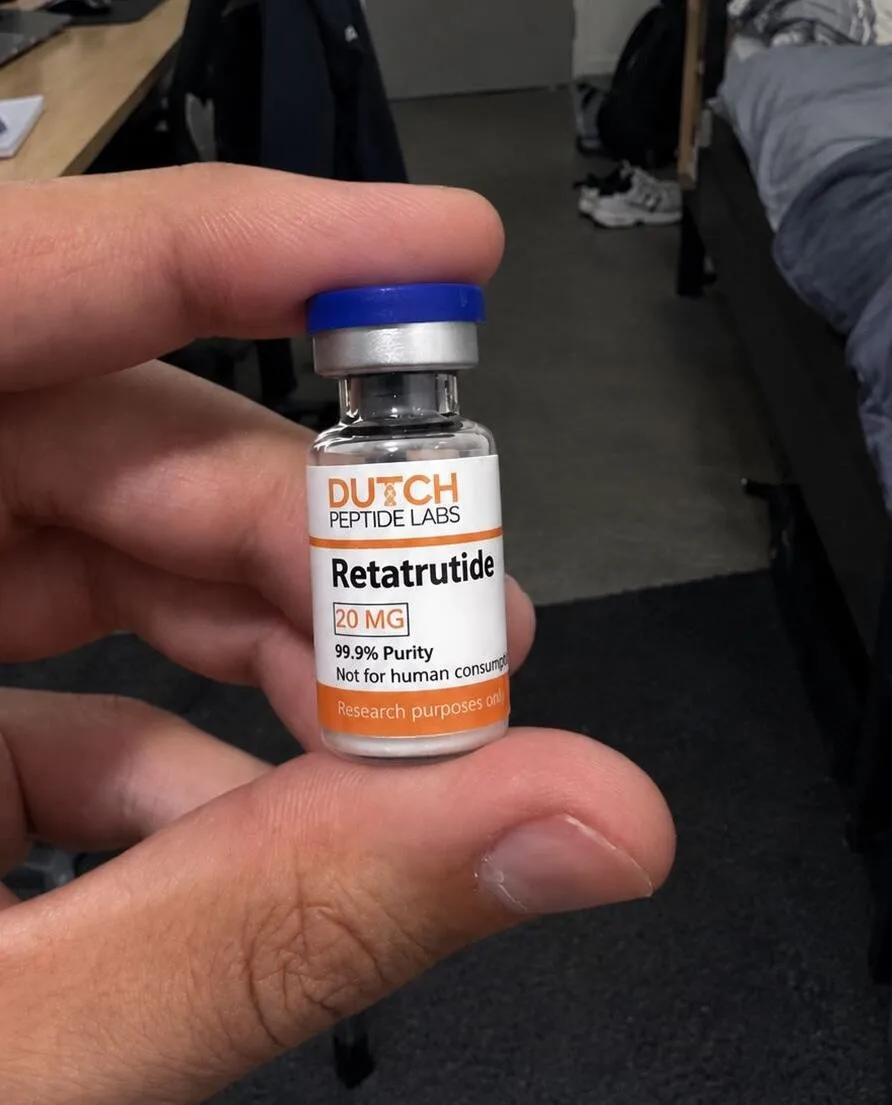





Research peptides are almost always ordered with a specific sequence, but anyone looking closely at the specification often also sees a note about the termini: free N-terminal amine, free C-terminal acid, or an acetylated or amidated variant respectively. These seemingly small chemical details at the head and tail of a peptide sequence have a measurable influence on the chemical stability of the molecule in a test set-up. This article discusses why the termini of a peptide are vulnerable, how N-terminal acetylation and C-terminal amidation address that, and what it means for the design and interpretation of laboratory research.
Why the termini of a peptide are vulnerable
An unprotected peptide has a free amine group at one end (the N-terminus) and a free carboxylic acid group at the other (the C-terminus). Published biochemical literature describes extensively that these are precisely the points of attack for exopeptidases: aminopeptidases cleave amino acids from the N-terminus, carboxypeptidases do the same from the C-terminus. In a test system where such enzymes are present — serum or tissue homogenates used in preclinical research, for example — this is an important degradation route alongside the oxidation, deamidation and hydrolysis that can occur elsewhere in the sequence.
N-terminal acetylation: mechanism and application
In acetylation an acetyl group (CH3CO-) is chemically coupled to the free amine group of the N-terminus, usually during solid-phase synthesis. Two effects are documented in the literature. First, the positive charge of the free amine group disappears, which can alter the conformation of the molecule and its interaction with other components in a test system. Second, the acetylated N-terminus is no longer a substrate for aminopeptidases, so that specific degradation route is blocked. This is also a modification that occurs naturally: many endogenous proteins and peptides are acetylated post-translationally, and synthesised research analogues with this modification are used to mimic that natural situation in an experimental model.
C-terminal amidation: mechanism and application
Amidation converts the carboxylic acid group (-COOH) of the C-terminus into a primary amide (-CONH2). Published research describes this conversion as greatly reducing susceptibility to carboxypeptidase activity, because the enzyme does not recognise the amidated bond in the same way as the free acid group. As with acetylation, this is a modification occurring frequently in nature: a large proportion of known signalling peptides are C-terminally amidated. For research purposes this means an amidated analogue behaves differently in an in vitro degradation model from the free-acid variant of the same sequence, which is relevant when interpreting comparative stability data.
Consequences for experimental design
For anyone setting up stability or degradation studies, the distinction between free and modified termini is no side issue. Two analogues with an identical amino acid sequence but different terminal chemistry can show materially different degradation kinetics in the same test system, simply because the points of attack for exopeptidases differ. That makes it important to:
- state the terminal modification explicitly when documenting a sequence, alongside the amino acid code itself;
- use the same terminal variant throughout comparative experiments, unless the effect of the modification is itself the subject of the research;
- allow for a mass shift in mass spectrometric data — acetylation and amidation change the molecular weight in a predictable, calculable way.
Analytical verification of the modification
The presence and completeness of a terminal modification can be verified with the same analytical techniques used for other quality checks. Mass spectrometry shows a characteristic mass shift relative to the unprotected sequence: acetylation adds approximately 42 Da, amidation lowers the mass by approximately 1 Da relative to the free acid form. HPLC retention times shift as well, because the polarity of the terminus changes. A certificate of analysis that names the terminal modification explicitly and supports it with mass spectrometric data gives researchers a direct way of checking that the material received matches the specification ordered.
These products and information are intended solely for laboratory and research purposes. Not intended for human or animal consumption, diagnostic use or therapeutic application.